My Hope

Some people have internal struggles that others don’t know about. They sometimes share their inner turmoil with the people closest to them. This mental, emotional, and spiritual anguish may be related to doubt, worry, lust, anger, guilt, inadequacy, overcoming a particular sin, carrying heavy responsibility, grief, depression, loneliness, or other issues that, through repeated cycles, can lead to despair.

I have had some of these internal struggles at times in my life, and have found various sources of help and encouragement. Learning how other people have persevered is one such source of help. One of these people is William Cowper.

William Cowper (1731-1800) was an English poet and hymn writer best known for his friendship with John Newton (author of Amazing Grace) and for his hymn, There Is A Fountain Filled With Blood. He wrote many other hymns as well. Cowper (pronounced “Cooper” – say it right in your head as you read this 🙂 ) was plagued with internal struggles for much of his life. He was even institutionalized for a few years for insanity. Through the years when experiencing waves of internal turmoil, Cowper found hope in Jesus.

One of his hymns has especially encouraged me and may help you. It expresses his longing to be free from the chains of earthly life and to be in the presence of His Savior. I have written it inside the cover of my Bible as a reminder of my hope. The waves of doubt, burden, and inadequacy that threaten to overwhelm only intensify my longing to be with Him.

To Jesus, the crown of my hope,
my soul is in haste to be gone;
oh, bear me, ye cherubim, up,
and waft me away to His throne.

My Saviour, whom absent I love;
whom not having seen, I adore;
whose name is exalted above
all glory, dominion, and power–

Dissolve Thou these bands that detain
my soul from her portion in Thee,
ah! strike off this adamant chain,
and make me eternally free.

When that happy era begins,
when arrayed in Thy glories I shine,
nor grieve any more, by my sins,
the bosom on which I recline–

Oh, then shall the veil be removed!
and round me Thy brightness be poured;
I shall meet Him whom absent I loved,
I shall see whom unseen I adored.

And then, never more shall the fears,
the trials, temptations, and woes,
which darken this valley of tears,
intrude on my blissful repose.

William Cowper

I Went to Church Last Night

I talked to people. A teacher led us through a study and discussion of Mark 12. I prayed with three other men. I went home.

As I left, I realized I felt spiritually nourished and refreshed.

But I go to church all the time. Because I’m a Christian, and because I’m a pastor, and because I live under religious freedom. And I confess I take it for granted. Talking to Christians, studying the Bible together, and praying for one another is not only normal, it’s routine. And sometimes it feels like a routine.

What made the difference last night?  I think it was the fact that I have been away from my church family for about three weeks. I just returned from a ministry trip consisting of long travel days, preaching numerous times, and encouraging others in their ministries. I gave out more than I took in. I came home physically exhausted and spiritually spent. I was hungry for fellowship. I had wonderful times with Christians and people in ministry during the past few weeks. I was refreshed by being with them. But I missed my people. My church. Last night was like coming home and having a meal with my family.

Have you ever sat down to a meal and realized as you began to eat that you were really hungry? That’s what last night felt like. I didn’t realize how hungry I was for fellowship until I tasted it.

What I experienced last night renewed my appreciation for what I often take for granted. I love the people in my church, and I missed them. I need them, and I need the strength I draw from being with them. Yes, even the pastor needs this.

It also reminded me that Christians grow weary and hungry. The times we gather to praise the Savior, learn from the Word, and pray for one another provide much needed nourishment and refreshment. It can become routine, and we can take it for granted. Extended travel or periods of sickness may interrupt our fellowship. Hopefully our times away heighten our appreciation for being with fellow Christ-followers.  And as a pastor, I have the opportunity to facilitate and provide these times of spiritual renewal for our people week by week.

I’m really glad I went to church last night. I think I’ll go again Sunday :). In fact, I’m looking forward to it.

Five Benefits of Translating from the Greek Text when Preparing a New Testament Sermon

image19This is primarily for preachers, but others may enjoy reading it. And I’m specifying the New Testament because I don’t translate from Hebrew. I rely on language helps for my understanding of Old Testament Scripture. My minor in college was Greek. I won’t tell you what my grade was in my seminary Hebrew class.

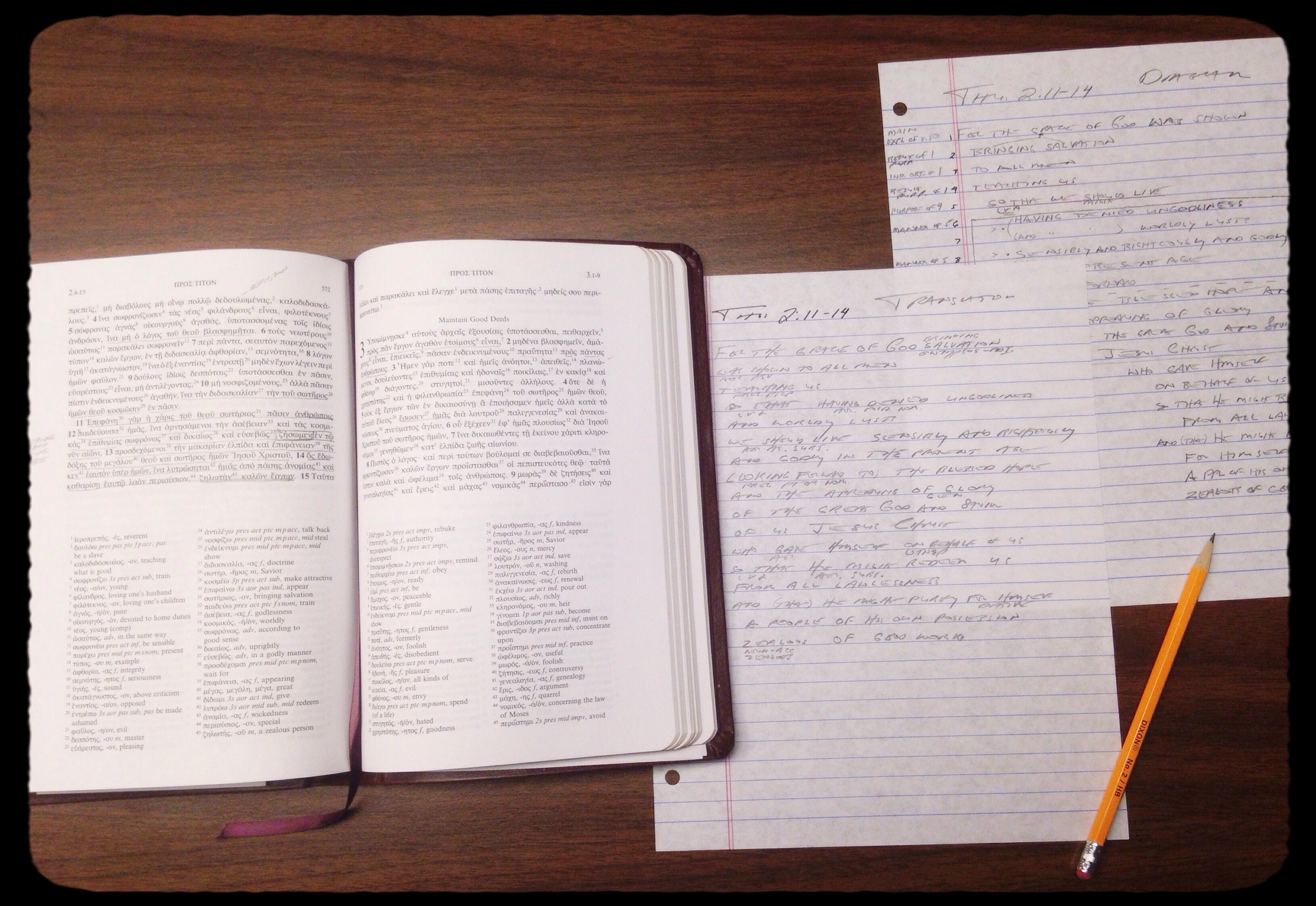
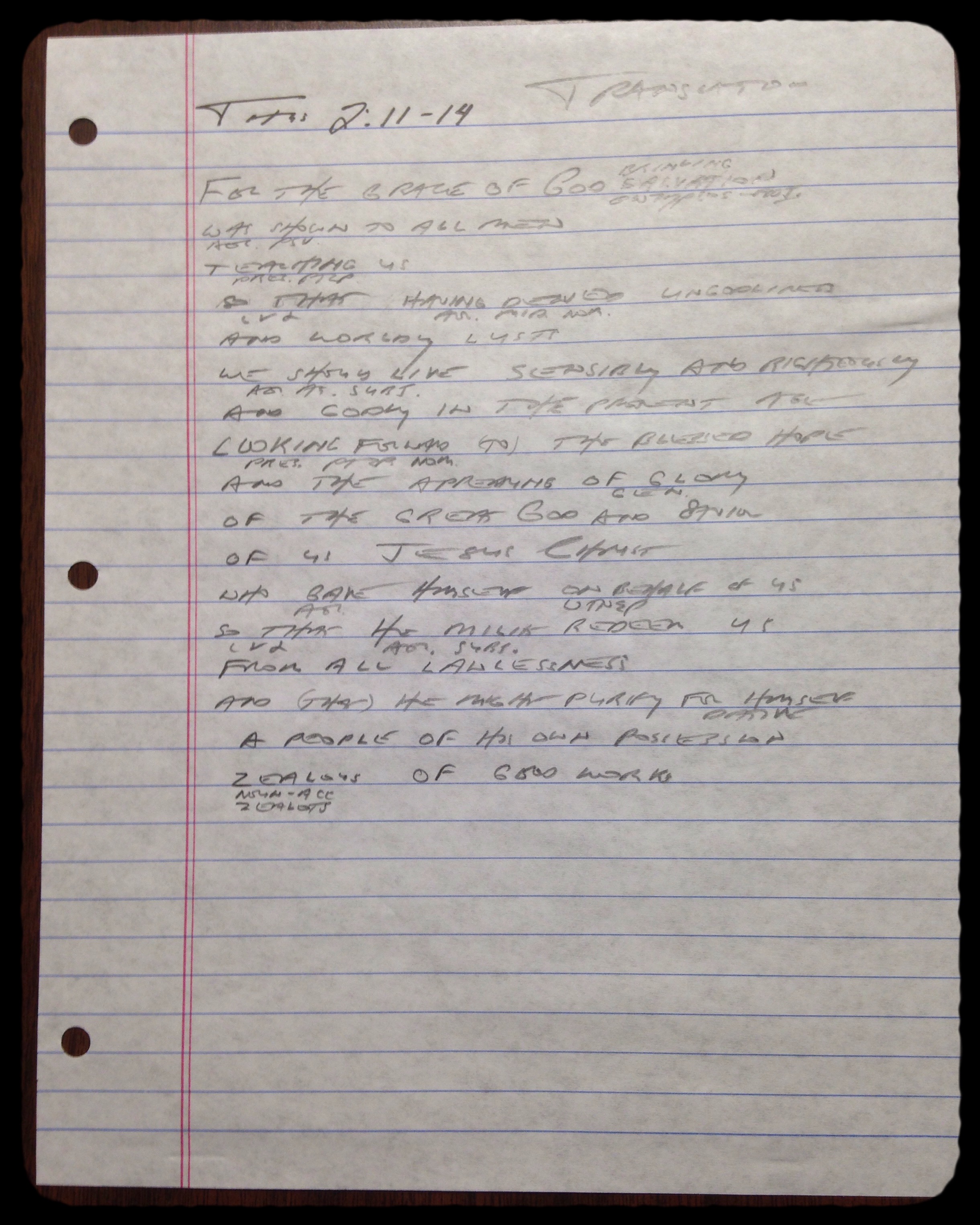
When I am preparing a sermon from a New Testament passage, I usually translate the text from Greek into English, especially if it is a didactic section. If it is narrative, I will usually at least read through it in Greek and note key words and grammatical features. It takes time. I may spend from 20 minutes on a shorter passage up to an hour or more on a longer one. But it’s always worth whatever time and effort I invest.

Here are five benefits:

  1. Translating forces me to look closely at the meanings of the individual words. If I am just studying from an English translation, I may not think beyond the first meaning of the word that comes to mind. But if I am translating, I am more likely to consider the depth and nuances of meaning contained in a single vocabulary word. Sometimes the meaning is what it is – the English word captures it well – but translating makes me think about that meaning carefully. Often the meaning is richer than I would have realized by merely considering the English word. I regularly find myself making copious notes about the meaning and significance of a single word when I pursue its Greek definition and its uses in other places in the New Testament and in outside literature.
  1. When I translate, I notice detailed grammatical data that I would be ignorant of otherwise. Translating requires an analysis of verbs, nouns, adverbs, adjectives, and participles. The different forms of each one have significance. The construction sometimes just contributes to the flow of the sentence. Often, however, the forms of these parts of speech contain data that makes the author’s meaning clear or provides added insight into a particular instruction or truth. Recently I preached from 1 Thessalonians 5:24, He who calls you is faithful, who also will do it. “Calls” obviously refers to God’s initial call to salvation through the gospel, right (cf. 2 Thessalonians 2:14)? But the verb in 1 Thessalonians 5:24 is in the present tense. A literal translation is, “the one calling you”. You could even say, “the one who is continually calling you”. An expanded translation might be, “the one who called you and is still calling you.” The ongoing call of God in our lives has implications that I can include in my sermon. Understanding the significance of the present tense enriches the meaning of the word and increases the impact of the truth on our lives. This is just one simple example. There are many additional ways, and more complex ways, that knowing the grammatical data increases understanding of the text.
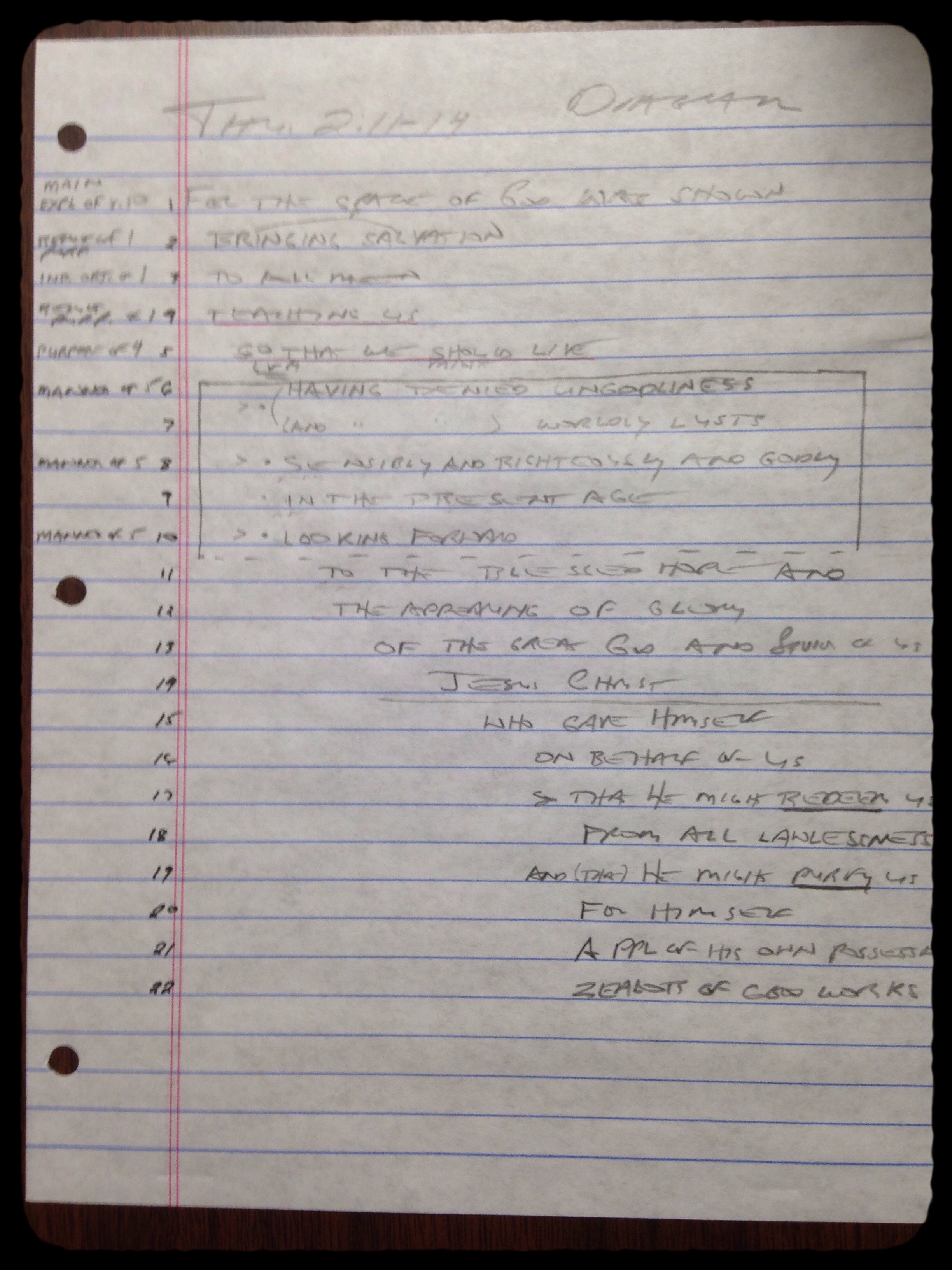
  1. The original text often reveals the main idea, proposition, or “kernel” of a section of Scripture. When first reading over a paragraph of the Bible, it may appear that all of the sentences and phrases contribute equally to the meaning of the passage. However, in language, there is always a kernel, usually a subject and verb structure, or a command, or a main proposition that everything else in the passage modifies. This kernel is often clear in the English text, but not always. Sometimes participles are translated as regular verbs. Frequently a passage contains a lengthy, complex sentence, especially in Paul’s epistles. Translating forces you to find that kernel and build everything else around it. Looking at the Greek grammar often reveals which parts of a sentence or paragraph are the main ideas and which are subordinate. I use this information to build my block diagram, a visual display of the main ideas and the relationship to them of subordinate clauses. The main ideas portrayed in the diagram often become the main points of my sermon. This information is invaluable in developing a message that accurately reflects the meaning and emphasis of God’s Word.
  1. By translating, I become intimately familiar with the text. This may sound like a restatement of everything above, just in more general terms. But I’m talking about a personal, heart level familiarity, not just detailed knowledge of the technical elements. It’s kind of like having an old car that you have worked on, not only wiping off the engine occasionally, or just changing the oil, but rebuilding the engine from inside out. You know that engine. You know how every part of it fits together; you know how the simple and the complicated parts work; you know what is producing that squeak you hear when it idles. You know that it will get you from point A to point B. It’s that way with the text of Scripture. When you “take it apart” and “rebuild” it, you know it inside out. And that intimate knowledge of truth should increase the personal impact of it on the preacher before he presents it to others.
  1. The detailed study, comprehensive knowledge, and heart-level familiarity with the text give me confidence when I preach. I know what it means, so I am able to explain it to my listeners with confidence. I have learned the significance of vocabulary words and grammatical data. I know what the main ideas are and how the rest of the text supports them. This is not a proud confidence, but a confidence nonetheless. I can know that I am following Peter’s instruction to be sure that when I speak, I “speak as the oracles of God” (1 Peter 4:11a). I can say to my congregation, “This is what God says.”